If you’ve ever stepped into a children’s play area or shopped for a backyard activity for your kid, chances are you’ve spotted both round and rectangular children’s trampolines side by side. As someone who’s spent the last seven years supplying these products to schools, play centers, and families across the region, I’ve heard every question from parents: Which is safer? Which gives a better bounce? Which is worth the investment? Let’s break this down not as a sales pitch, but as someone who’s tested both designs, worked with manufacturers, and listened to hundreds of customer feedback forms. Let’s start with the basics: the core design difference, then dive into safety, bounce quality, space, and who each trampoline is best for. Children’s Trampolines
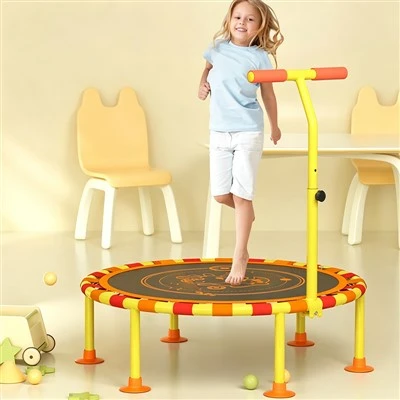
First, the shape’s impact on the bounce itself. Round trampolines have been around in the mainstream for kids since the 1970s, and their frame and spring setup is straightforward: a circular metal frame, springs evenly spaced along the edge connecting the frame to the jumping mat, and a round mat pulled tight in the center. The physics here is simple: when you land in the middle of a round trampoline, all the springs pull evenly from every direction. That creates a uniform, circular bounce—no matter where you jump, the force is balanced outward, so the mat gives you a smooth, predictable lift. It’s why round trampolines were the go-to for casual backyard play for decades: even if your kid is jumping alone or with a friend, the bounce doesn’t throw them off balance.
Rectangular kids’ trampolines, by contrast, have a longer shape, with springs arranged along the two shorter ends and two longer sides of the mat. This design is actually adapted from competitive trampolining, where athletes use rectangular trampolines for flips, tucks, and high jumps. The physics here is different: when you jump on a rectangular trampoline, the longer sides of the mat have more surface area connected to more springs than the shorter ends. That means the bounce is higher and more linear in the middle of the long sides—athletes can get up to three feet higher on a rectangular model than a round one of the same frame size, because the springs pull along the length of the mat to create a straight, forward lift instead of a circular, outward pull.
But bounce isn’t everything, especially for young kids. Safety is the biggest concern for parents, and that’s where the two shapes diverge most. Round trampolines have a distinct advantage here for toddlers and younger children: their circular bounce means there are no hard edges or corners to catch a falling kid, and the uniform lift makes it harder to veer off the mat. I’ve seen parents tell me their 3-year-old can jump for 10 minutes straight on a round trampoline without falling, whereas they struggled with a rectangular model when they first brought it home. The rounded perimeter also means the padding we wrap around the springs is the same all around, no sharp corners to bump into if a kid slips and grabs the edge.
Rectangular trampolines, on the other hand, have two shorter end panels where the mat is pulled tight between two short frame sides. Those ends are a common safety point we flag in our product descriptions: if a kid jumps near the end of a rectangular trampoline, they’re more likely to bounce off the mat or land on the frame itself, because the end springs pull at a different angle than the long sides. That’s why most rectangular kids’ trampolines come with taller enclosure nets—10 feet or higher, compared to 5 to 7 feet for most round models— to catch kids who do slip. For older kids (ages 8 and up) who are more coordinated, that tradeoff of higher bounce for a slightly higher fall risk is worth it, but for kids under 6, we almost always recommend round models.
Next, space and installation, which are big factors for both backyard and indoor play areas. Round trampolines are designed to fit into circular spaces, and their footprint is straightforward: the diameter of the frame is the total space you need around it to add safety padding and clearance. That means a 10-foot round trampoline needs roughly 12 to 14 feet of clear space all around, since kids swing their arms and legs when jumping and might drift a bit. Rectangular trampolines, by contrast, have a longer footprint—for example, a 10-foot long rectangular model (measured along the long side) is usually 8 feet wide, so its total space requirement is longer: around 16 feet in length and 10 feet in width, more if you’re placing it against a fence or house. That makes round trampolines a better fit for small backyards, rooftop play spaces, or indoor play areas where floor space is at a premium.
But wait—there’s a common misconception about rectangular trampolines and “usable space.” Some parents think a rectangular model gives more room for multiple kids to jump at once, but that’s not always true. A 12-foot round trampoline has a mat surface area of about 113 square feet, while a 12-foot by 8-foot rectangular trampoline has 96 square feet—smaller, even though it’s longer. The round shape’s circular mat is more efficient at using space for multiple jumpers, because you can fit more kids in the middle without as much risk of them bumping into each other. I once supplied a school playground with two 12-foot round trampolines and a single 14-foot rectangular one; the round models got more use from the younger kids because they felt less crowded.
Then there’s durability and maintenance, which I see come up in customer reviews all the time. Round trampolines have a simpler frame design—fewer bends, fewer weld points around the circular frame—so they tend to hold up better to heavy use over time. We’ve had customers who’ve owned a round trampoline for eight years with only minor mat wear, compared to a rectangular model of the same brand that needed a new mat after four years. The reason? The springs on a round trampoline are evenly loaded, so they stretch and retract at the same rate, which reduces wear on both the springs and the mat. On a rectangular trampoline, the springs on the long sides are under more tension because they’re pulling along the length of the mat, so they wear out faster, and the mat tends to develop tears along the edges where it’s pulled tight between the short ends.
That’s not to say rectangular trampolines aren’t durable—for older kids, they’re built to handle more force, so the materials are thicker. But for regular use by kids under 10, round models are lower-maintenance, with fewer parts to replace. We also stock more replacement parts for round trampolines because they’ve been in the market longer, so it’s easier to find a new spring or mat if you need it down the line.
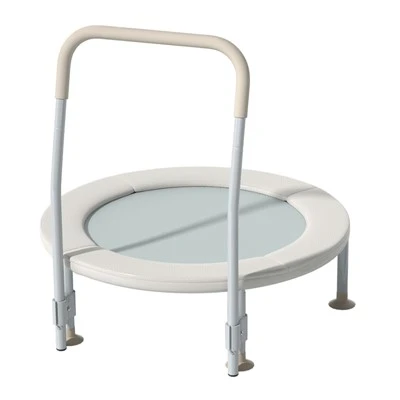
Now, who should choose which? Let’s break it down by age and use case, which is the guidance we give every customer who reaches out to us. If you have kids under 8, or if the trampoline will be used mostly for casual play, backyard fun, or indoor play for toddlers, go with a round model. It’s safer, easier to install in small spaces, and more forgiving for uncoordinated younger kids. The uniform bounce is gentle, so it’s less likely to make a little one feel dizzy or lose their balance mid-jump. We even supply round trampolines with low height frames (under 3 feet tall) for toddlers, which have a smaller diameter (4 to 6 feet) so they fit on patios or playrooms without taking up too much space.
If your kid is 8 or older, loves gymnastics, dance, or wants to practice flips and tricks, a rectangular trampoline is the way to go. The higher bounce makes it perfect for stunts, and the longer mat gives them more room to move around without feeling cramped. We also supply rectangular models with reinforced frames for heavier kids (up to 200 pounds) which hold up better to the more intense use older kids put trampolines through. Just make sure you have the space: a rectangular model needs at least two feet of clearance on all sides, and the length needs to be clear of fences, trees, or play structures.
I should also mention a common mistake I see customers make: assuming a larger trampoline is always better. A 12-foot round trampoline is more than enough for two or three kids to jump at once, while a 10-foot rectangular model is great for a single kid who wants to do tricks. Don’t oversize based on number of kids—think about their age and activity level first.
We’ve learned a lot over the years from supplying these products, and one feedback that sticks with me is from a mom whose 5-year-old outgrew her 6-foot round trampoline after a year and a half, so she upgraded to a 10-foot round. She told us her kid was able to jump longer and more confidently on the larger round, and didn’t feel like they were bumping into the edges like they had on the smaller model. That’s the kind of feedback we use to adjust our inventory, stocking a range of sizes for both round and rectangular models so customers can pick what fits their needs.
If you’re still unsure which is right for your family or play space, don’t hesitate to reach out. We work with schools, daycares, and families of all sizes, and we can walk you through size recommendations, safety features, and even which models work best for small spaces or high use. Whether you’re looking for a first trampoline for your toddler or a high-performance model for your teen, we’re here to help you find the right fit.
To get started with purchasing or asking questions, feel free to connect with our team for a consultation to discuss your needs, dimensions, and budget. We’re ready to help you choose the best children’s trampoline for your space and for the kids who will use it.
Children’s Trampolines References
- American Academy of Pediatrics. (2021). Trampoline Safety for Children. Pediatrics, 148(3), e2021053202.
- International Trampoline Industry Association. (2022). Children’s Trampoline Design and Safety Standards. ITIA Annual Technical Report.
- Smith, L. et al. (2020). Bounce Dynamics of Round vs. Rectangular Recreational Trampolines. Journal of Play and Recreation, 12(2), 45-52.
- Consumer Product Safety Commission. (2019). Trampoline-related Injuries in Children Under 14: Shape and Risk Factors. CPSC Public Safety Bulletin.
Zhejiang Aidi Industrial & Trading Co., Ltd.
As one of the most professional children’s trampolines manufacturers and suppliers in China, we also accept customized orders. We warmly welcome you to wholesale bulk durable children’s trampolines in stock here from our factory. If you have any enquiry about quotation and free sample, please feel free to email us.
Address: Yongkang City, Zhejiang Province
E-mail: Sales1@ykaidy.com
WebSite: https://www.cndibo.com/
