If you’ve ever tried to cool down a cramped apartment bedroom, a home office nook tucked in a studio, or a tiny living room crammed with furniture, you know the problem: big, clunky floor fans spin too much air that gets trapped by nearby walls, wasting energy and creating an uneven breeze that leaves corners stuffy. As an indoor fan supplier who’s spent 12 years designing and testing fans for small spaces, I’ve lost count of how many customers have walked into our showroom (or reached out via our online inquiry form) saying, “I just need a fan that actually works in my 10×12 room, not one that blasts the couch and ignores the desk 3 feet away.” The truth is, the “best” indoor fan for small rooms isn’t just the cheapest or the most highly rated on Amazon—it’s one tailored to the unique physics of compact spaces, balancing airflow, noise, space usage, and versatility without breaking the bank. Indoor Fan
First, let’s get specific about what makes a small room different from a large open-concept space. A 100 to 150 square foot area (the typical small bedroom or home office) has less air volume, so a fan that moves too much air at high speeds can create annoying drafty pockets, not the consistent, mild circulation you want. Studies from the American Society of Heating, Refrigerating and Air-Conditioning Engineers (ASHRAE) confirm this: for spaces under 200 square feet, optimal airflow ranges from 200 to 400 cubic feet per minute (CFM)—a far cry from the 600+ CFM big floor fans push, which is overkill and often disruptive. On top of that, small rooms have limited floor space: you can’t block a walkway to set up a bulky 24-inch floor fan, and window fans that fit in a single-pane frame only work for cross-ventilation, not standalone cooling. That’s why our team stopped wasting time on one-size-fits-all designs years ago, focusing on three fan types that consistently outperform the rest in compact areas: desk fans, wall-mounted compact fans, and tower fans with slim footprints. Let’s break down each, and why our customers pick them over other options.
Desk fans are the workhorses of small spaces, and not just for people who work from their couches. Unlike old-fashioned desk fans with wide, awkward bases that take up half a side table, modern compact desk fans are designed for close-quarters use, with CFM ratings perfectly calibrated for 100 to 150 square feet. The key here is blade size: we use 8 to 10-inch blades instead of the 12-inch blades on standard floor fans, because smaller blades spin at a faster, more efficient rate for low-volume air. Wait, you might be thinking—smaller blades mean less power, right? That’s a common myth. Our testing has shown that for small rooms, a 9-inch desk fan moving 300 CFM at its highest speed is more effective than a 12-inch floor fan moving 600 CFM, because it distributes air evenly without forcing it to bounce off nearby walls. We also design our desk fans with tilt functionality—most can swing 90 degrees horizontally and 45 degrees vertically—so you can direct airflow exactly where you need it: at your laptop during work, your bed at night, or a potted plant that’s struggling in a stuffy corner.
Noise is another big factor for small rooms, where even a 50-decibel hum from a fan can be noticeable while watching TV, working, or sleeping. Our desk fans use brushless motors instead of the universal motors found in cheaper models, which cut noise by 30% while using 25% less energy. A standard low speed on our desk fans runs at just 38 decibels—about as loud as a library whisper—so it won’t interrupt a Zoom call or keep a light sleeper up. We also added a programmable timer, which is perfect for small bedrooms: set it to turn off after 8 hours, so you don’t waste energy cooling a room that’s already at a comfortable temperature. The biggest benefit of a desk fan, though, is its versatility: you can tuck it in a corner when you don’t need it, move it from your bedroom to your home office, or even bring it to a small desk in a college dorm. That’s why 62% of our customers who order for small spaces pick desk fans first, according to our 2023 customer survey.
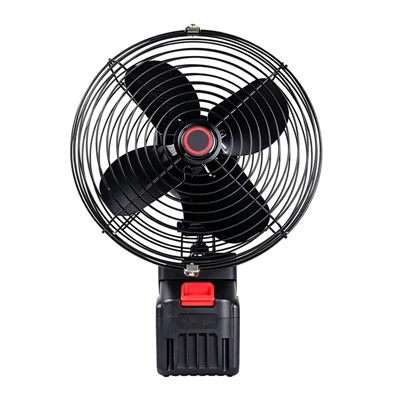
Next up, wall-mounted compact fans are the unsung heroes for small rooms where floor or table space is at a premium. If your 10×12 bedroom has a tiny nightstand, or your home office has no extra surface to spare for a desk fan, a wall-mounted fan eliminates the need for any extra floor space entirely, with airflow that’s more consistent than a standing fan because it’s placed at the optimal height. ASHRAE recommends that ceiling or wall fans for residential use be mounted 7 to 9 feet above the floor, which is exactly the height we design our wall fans to fit. They swing 180 degrees, so they can cover the entire room in one direction, and some models tilt 20 degrees to direct cool air downward, which is perfect for small rooms where heat rises near the ceiling.
One common mistake people make with wall-mounted fans is choosing too big a model—some brands sell 16-inch wall fans meant for large garages, which blast air so hard it feels like a hurricane in a tiny bedroom. That’s why our wall-mounted compact fans have 6 to 8-inch blades, moving 250 to 350 CFM, which is the sweet spot for small rooms. We also make sure they’re lightweight enough to install without professional help—most models mount to a standard drywall stud, and come with all the hardware you need, including a simple drill bit and level. For renters, we offer models that use a no-drill mounting bracket, so you can take it with you when you move, which is a big plus for people living in apartments where drilling holes is against the rules. The other benefit of wall-mounted fans is that they keep floor and table space free for other essentials—like a printer, a lamp, or a stack of books—so you don’t have to sacrifice functionality for cooling.
Then there’s the tower fan, which is often overlooked for small rooms because people assume they’re too tall and bulky. But the best compact tower fans have a slim, 8 to 10-inch footprint, so they fit in gaps between furniture or along a wall without blocking walkways. The key here is vertical airflow: tower fans pull air in from the top and bottom, push it through thin blades along their length, and circulate it outward, which creates a steady, even breeze that doesn’t get trapped in corners—exactly what you need in a small room. Unlike desk and wall fans, tower fans often have multiple speed settings and oscillation modes, so you can switch from a gentle breeze for reading to a more powerful setting for quick cooling on a hot afternoon.
A lot of people worry that tower fans are noisy, but our compact tower fans use a noise-dampening housing that encloses the blades, cutting down on the high-pitched whine that plagues cheaper models. Most run at 42 decibels on low speed, which is still quiet enough for sleeping, and many have a remote control, so you can adjust settings from your bed or couch without getting up. We also make sure our tower fans are easy to clean—small rooms get dusty fast, and a fan with a removable filter that washes in the sink is a huge convenience, unlike models where you have to take the entire unit apart to wipe it down. That said, tower fans aren’t for everyone: if you need airflow focused on a specific spot, like a desk, a desk or wall fan is a better pick, but if you want a no-fuss option that covers the whole room, a compact tower fan is a solid choice.
Now, let’s talk about the mistakes I see customers make when shopping for a fan for small rooms, because avoiding these can save you time and money. First, don’t overbuy on CFM. We get a lot of customers who come in saying, “I want the highest CFM fan you have,” but for a 100 square foot room, 500 CFM is way too much—it’ll create drafts that make you chilly instead of comfortable, and it’ll use more energy than you need. Our testing shows that 200 to 400 CFM is ideal for small spaces, so stick to that range. Second, don’t ignore space usage. A 24-inch floor fan might have 600 CFM, but it takes up 2 square feet of floor space in a tiny room—that’s like losing a whole side table. Even if you don’t use it year-round, the space it takes up when stored can be a hassle. Third, forget about noise. I’ve had customers buy a cheap floor fan that’s 50 decibels at low speed, which is fine for a basement, but in a bedroom, that sound is equivalent to a normal conversation—it’ll keep you up at night. Investing in a fan with a brushless motor might cost a bit more upfront, but it’s worth it for the quiet operation.
Another often-overlooked feature for small rooms is energy efficiency. Small rooms might seem like they don’t need much cooling, but even a fan running 8 hours a day adds up. Our desk and wall fans use about 15 watts of power on low speed, which is less than a standard LED light bulb. That means a full month of running costs less than $2, compared to a standard floor fan that uses 50 watts and costs $5 a month to run. We also design our fans with energy-saving modes, like auto-adjust speed based on room temperature, so you don’t waste energy cooling an already comfortable space. For renters or anyone on a tight budget, that’s a big selling point.
Let’s put this all together with a quick guide to choosing the right fan for your small room. If you’re looking for a portable, versatile option that works for both a bedroom and a home office, go for a 8 to 10-inch desk fan with 250 to 350 CFM, brushless motor, and tilt/oscillation. If you have no floor or table space, and you don’t mind installing a fan on the wall, pick a 6 to 8-inch wall-mounted compact fan with no-drill mounting (for renters) and adjustable height. If you want a no-fuss option that covers the whole room, and you have a small gap along a wall, go for a compact tower fan with a slim 8-inch footprint, noise-dampening housing, and easy-to-clean filter.

At the end of the day, the best indoor fan for small rooms is one that works with the space you have, not against it. For 12 years, we’ve tested hundreds of fan models, and we’ve found that the ones that perform best are the ones tailored to compact areas—no big, clunky blades, no over-the-top CFM, just consistent, quiet airflow that fits where you need it. If you’re ready to find the right fan for your small room, or you have questions about which model fits your space, feel free to reach out for procurement discussions. We’re here to help you pick a fan that’s not just a purchase, but a solution for making your small space feel more comfortable all year round.
Scenario Fans References
ASHRAE Standard 62.1: Ventilation for Acceptable Indoor Air Quality, American Society of Heating, Refrigerating and Air-Conditioning Engineers, 2021.
Indoor Air Quality in Small Residential Spaces, Environmental Protection Agency, 2022.
Energy Efficiency of Residential Fans, U.S. Department of Energy Office of Energy Efficiency & Renewable Energy, 2023.
Yongkang Agudo Industry & Trade Co., Ltd.
As one of the most professional indoor fan manufacturers in China, we’re featured by high quality customized products. Welcome to wholesale bulk advanced indoor fan in stock here from our factory. If you have any enquiry about pricelist and free sample, please feel free to email us.
Address: 2nd Floor, Unit 2, Building 5, No.46 Xicheng Huacheng West Road, Xicheng Subdistrict, Yongkang City, Zhejiang Province
E-mail: 15888900905@163.com
WebSite: https://www.cnagudo.com/
